It is currently Thu Aug 27, 2026 5:22 pm

All times are UTC - 5 hours [ DST ]


Post new topic Reply to topic  [ 14 posts ] 
Author Message
 Post subject: That'll Buff Right Out
PostPosted: Sat Jun 19, 2010 8:14 pm 

Joined: Sun Oct 19, 2008 12:58 pm
Posts: 1352
Location: Chicago USA
Whenever you hear of someone restoring, say, an E or F there usually seems to be quite a few little dings in the nose to deal with, pounding out or Bondo-ing. So where do these come from? Not collision damage of course (hard to imagine a collision of any sort resulting damage that minor). Impacts with tree branches, rocks falling off overpasses (or maliciously hurled), icicles? I'm sure that's some of it. What else?

Steve


Offline
 Profile  
 
 Post subject: Re: That'll Buff Right Out
PostPosted: Sat Jun 19, 2010 9:02 pm 

Joined: Thu Feb 03, 2005 9:32 pm
Posts: 344
Most of the lumps on IRM’s E and F units come from the steel swelling into rust at the sills. I can’t tell you how much these things remind me of all the former GM cars I’ve owned.


Offline
 Profile  
 
 Post subject: Re: That'll Buff Right Out
PostPosted: Sat Jun 19, 2010 11:32 pm 

Joined: Mon Apr 30, 2007 12:45 am
Posts: 522
Location: Illinois
Dents in the lower portion of E and F unit doors (including the nose door), are often the result of trainmen kicking an uncooperative door to open or close it, such "sticking" often caused by rust swelling of the door and/or frame.

Jeff

_________________
Save the whales! Collect the whole set!
Image


Offline
 Profile  
 
 Post subject: Re: That'll Buff Right Out
PostPosted: Sun Jun 20, 2010 12:31 am 

Joined: Sun Jun 17, 2007 8:03 pm
Posts: 1115
Location: Warszawa, Polska
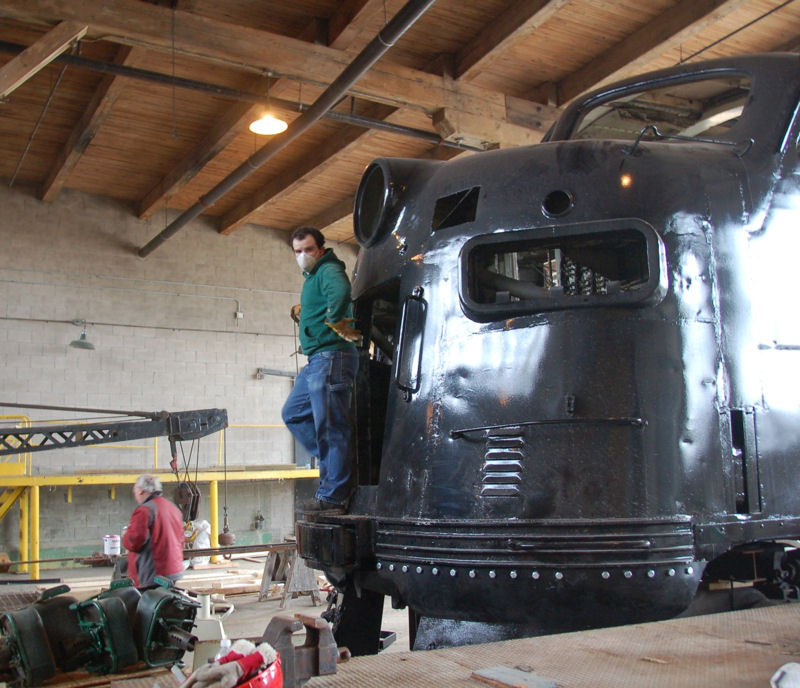
The Ex CNR F7 cab at the john street roundhouse certainly seems to have its fair share of dings and dents.

Image

_________________
CNR 6167 in Guelph, ON or "How NOT To Restore A Steam Locomotive"


Offline
 Profile  
 
 Post subject: Re: That'll Buff Right Out
PostPosted: Sun Jun 20, 2010 1:06 pm 

Joined: Mon Aug 23, 2004 3:01 pm
Posts: 1755
Location: SouthEast Pennsylvania
A letter to the editor of one of the enthusiast magazines about published photos of New Haven RR's newest passenger electric electric locomotives explained some of the dents in the lower noses. The person who connected the heavy steam hoses would signal the engine crew that it was safe to turn on the steam generator by pounding on the locomotive with the same hammer just used to assist in closing the hose couplings!


Offline
 Profile  
 
 Post subject: Re: That'll Buff Right Out
PostPosted: Sun Jun 20, 2010 11:30 pm 

Joined: Thu Feb 03, 2005 9:32 pm
Posts: 344
Jeff’s post got me thinking about lumpy GG1s.
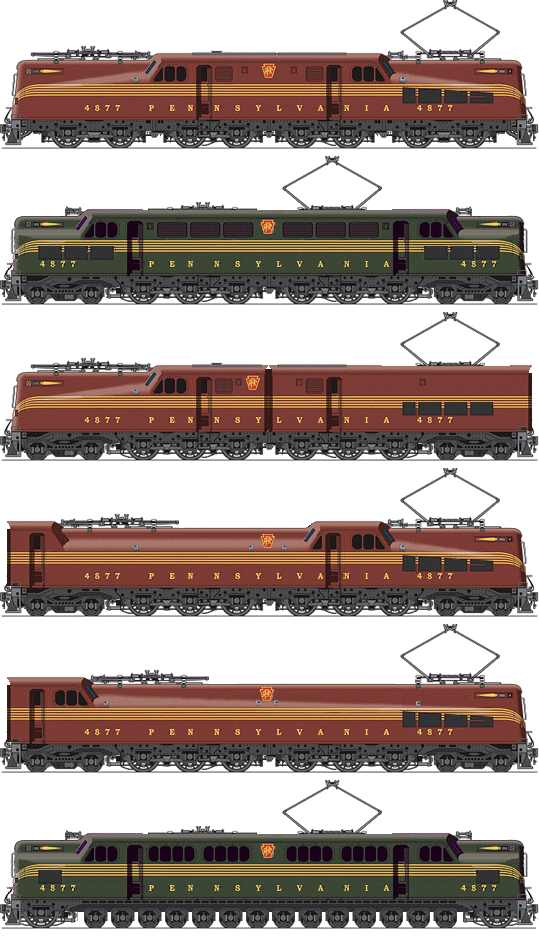
One of the most distorted car bodies at the IRM is the GG1. Looks almost as if it had been rolled. Check out this photo of 4930.
http://www.rrpicturearchives.net/showPi ... ?id=530754
Did GG1s pass through deep snow a lot, or just have thin sheet metal?


Offline
 Profile  
 
 Post subject: Re: That'll Buff Right Out
PostPosted: Mon Jun 21, 2010 2:27 am 

Joined: Mon Aug 23, 2004 8:44 am
Posts: 741
Location: Salt Lake City, Utah
The above pic of the CNR cab unit also looks like it's been stripped of the 'bondo' used to fill and smooth the weld seams on the nose at some point.

_________________
David Wilkinson
Salt Lake City, UT


Offline
 Profile  
 
 Post subject: Re: That'll Buff Right Out
PostPosted: Mon Jun 21, 2010 6:17 am 

Joined: Sun Jun 17, 2007 8:03 pm
Posts: 1115
Location: Warszawa, Polska
Eventually as work progressed on the CNR cab, they did fill in a lot of the bumps and bruises.

_________________
CNR 6167 in Guelph, ON or "How NOT To Restore A Steam Locomotive"


Offline
 Profile  
 
 Post subject: Re: That'll Buff Right Out
PostPosted: Mon Jun 21, 2010 10:44 am 

Joined: Sun Aug 22, 2004 1:51 pm
Posts: 12152
Location: Somewhere east of Prescott, AZ along the old Santa Fe "Prescott & Eastern"
Another factor that caused some pounding, I'm sure: Trying to pound loose moist/stuck sand from either the sandboxes or their passageways. As I recall, the sand on these locos is in a reservoir underneath and beside the engineer's and fireman's seats..... the square hatches are underneath the cab windows and beside the cab doors. And having had to try and deal with rust repairs inside a cab and right in this area, I second the rust theories as well.


Offline
 Profile  
 
 Post subject: Re: That'll Buff Right Out
PostPosted: Mon Jun 21, 2010 12:09 pm 
User avatar

Joined: Sun Aug 22, 2004 1:45 am
Posts: 1138
Location: Beaumont, Texas
buzz_morris wrote:
Jeff’s post got me thinking about lumpy GG1s.
One of the most distorted car bodies at the IRM is the GG1. Looks almost as if it had been rolled. Check out this photo of 4930.
http://www.rrpicturearchives.net/showPi ... ?id=530754
Did GG1s pass through deep snow a lot, or just have thin sheet metal?


I assume the GG1's skin is load bearing; in which case the wrinkling reminds me of the wrinking you see in the skin of B-52; and is result of years of twisting and pulling while (in the case of the B-52) the cabin areas underwent pressurization and de-pressurization.

_________________
-James Hefner
Hebrews 10:20a

Surviving World Steam Project - New Address!

International Stationary Steam Engine Society


Offline
 Profile  
 
 Post subject: Re: That'll Buff Right Out
PostPosted: Mon Jun 21, 2010 2:08 pm 

Joined: Thu Aug 26, 2004 2:50 pm
Posts: 2815
Location: Northern Illinois
Ditto. It's the same effect one sees on all weld boxcars, with the sheets bowing or warped between their line of attachment to the framing.

_________________
Dennis Storzek


Offline
 Profile  
 
 Post subject: Re: That'll Buff Right Out
PostPosted: Mon Jun 21, 2010 2:58 pm 

Joined: Sat Feb 06, 2010 9:29 am
Posts: 319
Interestingly, on B-52's, the wrinkles go away while inflight.......
I wonder if some of the E/F nose dings are the result of structural flexing? I have seen many GP's that have cracked and dented the sides of the electrical cabinet- mostly due to hard coupling.


Offline
 Profile  
 
 Post subject: Re: That'll Buff Right Out
PostPosted: Mon Jun 21, 2010 3:14 pm 

Joined: Tue Mar 02, 2010 5:03 pm
Posts: 261
Location: SE, Mich.
eze240 wrote:
Interestingly, on B-52's, the wrinkles go away while inflight.......
I wonder if some of the E/F nose dings are the result of structural flexing? I have seen many GP's that have cracked and dented the sides of the electrical cabinet- mostly due to hard coupling.

Hmm...interesting. I wonder if the dings in E/F's go away at speed?
-Runs for cover-

_________________
-Aaron Farmer
Manager, Mechanical
Steam Railroading Institute
Yield not to misfortunes, but advance all the more boldly against them.


Offline
 Profile  
 
 Post subject: Re: That'll Buff Right Out
PostPosted: Mon Jun 21, 2010 11:55 pm 

Joined: Fri Oct 01, 2004 1:33 pm
Posts: 483
Location: Oroville, CA
When preparing WP805A for painting, I took many wheelbarrow fulls of sand and rust out of the nose and under-cab area. Rust was so heavy in some spots from the sand that there are sections of the I beams with no center web. You can actually see the sag in the body on one side from the structural loss. Not many folks realize that the F units are built like a truss bridge and rely on the upper framework to keep the "floor" straight. It's just a bridge between the two truck bolsters. Some folks argued about my doing so much "unseen" work, but if you don't, it rots through to the outside.
Filling nose dents is about all one can do, sans large hydraulic-powered dent removal equipment--and torches too. That's some heavy metal there!
David D.

_________________
Steamcerely,
David Dewey
Hoping for the return to the American Rivers of the last overnight steamboat, Delta Queen!


Offline
 Profile  
 
Display posts from previous:  Sort by  
Post new topic Reply to topic  [ 14 posts ] 

All times are UTC - 5 hours [ DST ]


You cannot post new topics in this forum
You cannot reply to topics in this forum
You cannot edit your posts in this forum
You cannot delete your posts in this forum
You cannot post attachments in this forum

Search for:
Jump to: