2124,
The insulator you acquired is an Amstrong DP1 insulator. "DP1" is the "style number" of this particular insulator. Style numbers were used by the different manufacturers of insulators (Hemingray, Armstrong, etc.) to denote the different lines of insulators they were manufacturing. Each line of insulator served slightly different, and sometimes overlapping, purposes. The insulator collection community came up with a unified numbering identification system for all insulators made by the various manufacturers over the decades; the numbers of this system are known as "Consolidated Design", or "CD" numbers. The CD number for the DP1 is #155. CD #155 insulators replaced the earlier CD #154 insulators. Both the #154 and #155 insulators were "the standard for both telephone and telegraph use for many years." (The #154 insulators had previously replaced the even earlier #152 insulators.) Now, regarding the numbers 68 61 and the 3 dots :. During the course of production of a particular line (style) of insulator, which would normally last a number of years, from introduction until it was replaced and phased out by a newer style, multiple molds would be used at the factory to produce the individual insulators. When a particular mold would get older and start to wear out to the point that it would affect the quality of the product, it would be replaced by a new mold. To keep track of these multiple molds, they were numbered by the manufacturer. Therefore, your insulator was made by Armstrong using the 68th mold for the DP1 production line. The second number designates when this mold, or line, was introduced, and the 3 dots afterward represent the number of years after that time, so therefore, your insulator was produced in 1964. A little more info: Armstrong was the successor company to Whitall Tatum, which had originally begun the production of the DP1. Production of the DP1 continued under Armstrong's successor Kerr. Now, just because the Armstrong DP1 is a #155 insulator, doesn't mean that Armstrong was the lone manufactor of #155's: Hemingray also made #155 insulators, with style #45, which replaced the style #42 insulators of CD #154. The #152, #154, and #155 insulators are all examples of "side wire groove, double petticoat" insulators. A "wire groove" is the "square or concave section between the wire ridges on the side of the insulator that holds the line wire". "Double petticoat" refers to the fact that these insulators had 2 "petticoats", or "skirts": the "outer skirt", which is the "outer part of the insulator, from the wire ridge to the base", and the "inner skirt", which is the rim of the insulator's central bore, below the screws, where the insulator would rest on the pin. On the #155 insulators, the "inner skirt" does not extend below the "outer skirt" to form the insulator's actual base, but on other styles of insulators, it could. Your insulator should look something like this:
http://glassian.org/Gallery/155/arm_grnsmk.jpg

Vincent,
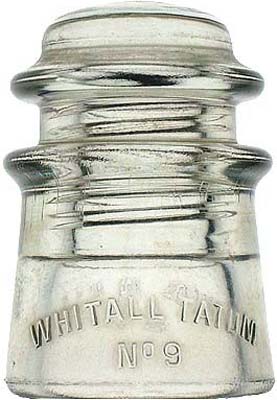
Your 2 Hemingray style #9 insulators could either be CD #106 or #107. #106 "was a standard style that replaced the CD 102 for small signal lines for both telephone and telegraph." The #106 is a "pony" insulator, pony being a "nickname for a number of smaller styles of insulators". The #9 insulators were "designed for rural telephone lines." The #107 insulators later replaced the #106 "because [they] used less glass and [were] generally more robust."
If your 2 #9 insulators are of CD #106, they should look something like these:
http://www.nia.org/general/cdimages/cd106.jpg
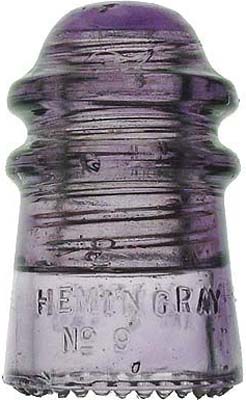
http://www.nia.org/general/cdimages/cd106_hemi_jade.jpg
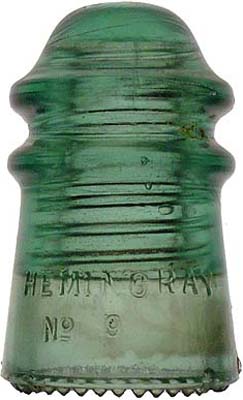
http://www.nia.org/general/cdimages/cd106_hemi_aqua.jpg
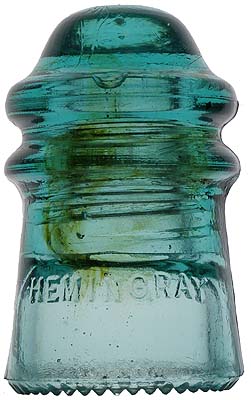
http://glassian.org/Gallery/106/mcl_apple.jpg

If your 2 #9 insulators are of CD #107, they should look something like this:
http://www.nia.org/general/cdimages/cd107.jpg
Sources:
1. Bill Meier's insulators.info website: http://www.insulators.info/
___1a. http://www.insulators.info/general/glossary/
___1b. http://www.insulators.info/general/faq.htm
___1c. http://www.insulators.info/general/styles/arm.htm
___1d. http://www.insulators.info/articles/woodward/cd155kpp.htm
2. Christian Willis' Hemingray website: http://www.hemingray.info/
___2a. http://www.hemingray.info/database/list-cd.php
___2b. http://www.hemingray.info/database/detail.php?cd=106
___2c. http://www.hemingray.info/database/detail.php?cd=107
___2d. http://www.hemingray.info/database/list-cd.php?page=2&perpage=40
___2e. http://www.hemingray.info/database/detail.php?cd=152
___2f. http://www.hemingray.info/database/detail.php?cd=154
___2g. http://www.hemingray.info/database/detail.php?cd=155
3. National Insulator Association's website: http://www.nia.org/
___3a. http://www.nia.org/general/gallery.htm
___3b. http://www.nia.org/general/g_natpt.htm
___3c. http://www.nia.org/general/cd_text/cd106.htm
___3d. http://www.nia.org/general/cd_text/cd107.htm
___3e. http://www.nia.org/general/g_natpt1.htm
___3f. http://www.nia.org/general/cd_text/cd152.htm
___3g. http://www.nia.org/general/cd_text/cd154.htm
___3h. http://www.nia.org/general/cd_text/cd155.htm
4. Glassian website: http://glassian.org/insulator.html
___4a. http://glassian.org/Gallery/cd100-144.html
___4b. http://glassian.org/CD/106/106.html
___4c. http://glassian.org/Gallery/cd145-184.html
___4d. http://glassian.org/CD/152/152.html
___4e. http://glassian.org/CD/154/154.html
_________________
Additions and corrections are welcome. Thanks in advance.