It is currently Sun Aug 23, 2026 11:26 am

All times are UTC - 5 hours [ DST ]


Post new topic Reply to topic  [ 38 posts ]  Go to page Previous  1, 2, 3  Next
Author Message
 Post subject: Re: The Reuse of Abandoned Railroad Bridges
PostPosted: Fri Sep 13, 2013 5:51 pm 

Joined: Wed Jan 23, 2008 2:46 pm
Posts: 76
Location: Virginia
There was a pedestrian bridge across the Utica NY NYC yard to allow men to get to and from the NYC roundhouse. Was at the foot of Culver Ave. That bridge was relocated in the early seventies to a sand and gravel plant in Poland NY to move material from a hillside to the plant. Still in use today.

_________________
BBH


Offline
 Profile  
 
 Post subject: Re: The Reuse of Abandoned Railroad Bridges
PostPosted: Fri Sep 13, 2013 6:21 pm 

Joined: Wed Dec 03, 2008 9:15 pm
Posts: 7
I've got another one. The Topeka streetcar system used to have a bridge over the Santa Fe yard. After the streetcar system was abandoned, a few sections of the bridge ended up as a replacement for 3 spans of the Santa Fe bridge over the Kansas River after the flood of 1951. They still stand in use today.


Offline
 Profile  
 
 Post subject: Re: The Reuse of Abandoned Railroad Bridges
PostPosted: Fri Sep 13, 2013 7:31 pm 

Joined: Sat Mar 17, 2012 12:11 am
Posts: 141
Location: North Carolina USA
In the context of historic preservation in regard to railroads specifically, I was looking for adoptive reuse in a museum or operating road devoted to preservation, although these are interesting examples of reuse... none the less.


Offline
 Profile  
 
 Post subject: Re: The Reuse of Abandoned Railroad Bridges
PostPosted: Fri Sep 13, 2013 7:49 pm 

Joined: Tue Aug 24, 2004 6:30 am
Posts: 773
The former Michigan Central / New York Central bridge in St. Thomas, Ontario was recently purchased by a group who intend on turning it into an elevated park....
http://www.ontrackstthomas.ca/


Offline
 Profile  
 
 Post subject: Re: The Reuse of Abandoned Railroad Bridges
PostPosted: Fri Sep 13, 2013 7:54 pm 

Joined: Mon Aug 23, 2004 8:10 am
Posts: 2499
My favorite bridges that have been moved for preservation?

The Reading iron bridge under the John Bull at the Smithsonian and the Barre RR covered bridge now at the White Mountains Central in NH. Two great preservation stories.

Rob


Offline
 Profile  
 
 Post subject: Re: The Reuse of Abandoned Railroad Bridges
PostPosted: Fri Sep 13, 2013 11:35 pm 

Joined: Wed Oct 13, 2004 12:56 am
Posts: 497
Location: Northern California
When the Great Northern Railway electrified the upper Cascade tunnel in about 1910, they built a dam and power house in Tumwater Canyon to supply 25 cycle power to run the railroad. At that time the mainline went down Tumwater canyon on the north side. The dam was about three miles upstream from the power house. The railroad built a very large pipeline, most of it wood, from the dam to the power house on the south side of the river. The power house was built on the north side of the river and a bridge was built to carry the pipe across the river. The pipe on the bridge was of riveted steel construction.

When steam was replaced by diesels, the railroad no longer needed the electric operation, which prevented the use of steam locomotives in first the upper tunnel and later in the lower, longer tunnel. The electric operation was shut down in 1956 and the Tumwater powerhouse was torn down. The State took over the penstock bridge and cut the top half of the pipe off and turned it into a trail to get people across the river. It is still in use. See this site.

http://www.wta.org/go-hiking/trip-repor ... oto1_large


Offline
 Profile  
 
 Post subject: Re: The Reuse of Abandoned Railroad Bridges
PostPosted: Sat Sep 14, 2013 11:18 am 

Joined: Sat Mar 17, 2012 12:11 am
Posts: 141
Location: North Carolina USA
David
Thank you for the link..an interesting example. The Big Four bridge that looms over Louisville came to mind which Interstate and then the Indiana Railroad had trackage rights
upon. I looked this bridge up ( I have seen it several times. It is enormous and abandoned and in place) Now I see it will become a causeway for pedestrians and bicycles.

Image


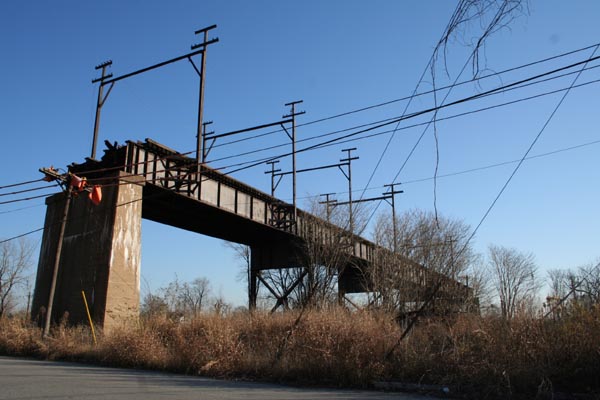
Another is the Illinois Terminal elevated line in St Louis that seems to be following the example of the "High Line" in NY, which is also a "green" causeway. Better preserved than not. As far as I know this isolated section still stands oddly isolated in East St Louis

Image

Another segment, the still standing Illinois Terminal McKinley Bridge crossing the Mississippi. Another re-purposed bridge for bicycles and pedestrians

Image

It might just be me, but the re-adoption of these and others in their uses strikes as more than a little ironic. Call it a de-evolution of public transportation.


Offline
 Profile  
 
 Post subject: Re: The Reuse of Abandoned Railroad Bridges
PostPosted: Mon Sep 16, 2013 5:23 pm 

Joined: Sat Apr 15, 2006 9:55 pm
Posts: 269
Location: San Diego area
Last June, I walked across the bridge in Tumwater Canyon posted by David Johnston. I didn't know anything about the history, but thought, "this trough sure looks like it was built of old locomotive boilers." I asked a friend who is in the GN Historical Society, and he reported essentially the same story as David did, except he said that it was always a trough, not a pipeline, and it was made of old boilers. He said that the trough was originally wood, but later replaced with the old boilers.

However, to me, the fact that it was a pipe, makes more sense, since the open trough would lose the pressure drop advantage in the two mile run from the dam to the power plant. I assume that in those days, a high pressure pipe would be built similarly to a boiler.


Offline
 Profile  
 
 Post subject: Re: The Reuse of Abandoned Railroad Bridges
PostPosted: Mon Sep 16, 2013 5:30 pm 

Joined: Sat Apr 15, 2006 9:55 pm
Posts: 269
Location: San Diego area
Another nice bridge on a "rail trail" is the bridge over the Mad River between Arcata and McKinleyville in northern California (near Eureka). The trail is about 5 miles long, mostly paved, and is on the former Hammond Lumber Co. ROW. &*#!!, can't find my pictures of it.

Interestingly, Hammond Lumber #17, a 2-8-2T is nearing completion of a major overhaul at Mt. Rainier Scenic RR.


Offline
 Profile  
 
 Post subject: Re: The Reuse of Abandoned Railroad Bridges
PostPosted: Mon Sep 16, 2013 6:31 pm 

Joined: Wed Oct 13, 2004 12:56 am
Posts: 497
Location: Northern California
Here is a little more on the Tumwater powerhouse and pipeline.

http://www.gngoat.org/tumwater_canyon.htm


Offline
 Profile  
 
 Post subject: Re: The Reuse of Abandoned Railroad Bridges
PostPosted: Mon Sep 16, 2013 6:52 pm 

Joined: Sat Apr 15, 2006 9:55 pm
Posts: 269
Location: San Diego area
David: The confusing part to me, and maybe my friend, is the photo that goes with the caption, "The original pipeline was made from wood staves. It is clear from this photo that at least part was replaced with half-inch steel pipe sometime later. The remains of the pipe in the nearby tunnel are wood stave. There is no evidence that the tunnel was bypassed, so at least part of the wood stave section was in use until the plant was closed. In 1927, the power plant was sold to the utility supplying electricity to the Great Northern for the new system."

The photo clearly shows a trough, not a pipe. But, is that water flowing through it, or the dirt that is now in it to make a walking surface? I can't tell from the photo. I wonder what the photo's date is.

But, I certainly agree that a pipe and surge tank make more sense than an open trough. If it was an open trough, some massive pumps would be needed to fill that tall tank. A pipe would do it with gravity.


Offline
 Profile  
 
 Post subject: Re: The Reuse of Abandoned Railroad Bridges
PostPosted: Mon Sep 16, 2013 7:18 pm 

Joined: Thu Aug 26, 2004 2:50 pm
Posts: 2815
Location: Northern Illinois
If a pipe is made of wood staves, it has to be a fully enclosed pipe; there is no way to put the staves in compression in a half round. Anyway, one of the photos shows a full round wooden pipe being constructed.

The photo of the half round trough is after conversion to a hiking path. Most people don't want to crawl through a couple hundred feet of pipe they can't stand upright in, so this is the logical fix. The gravel in the bottom of the pipe forms a flat walking surface.

Here is my nomination for the oddest preserved bridge, the Fox River Aqueduct on the I&M Canal in northern Illinois:

Image

Originally the iron box section carried the canal over the Fox River, with the towpath on a bridge along the south side of the aqueduct. Later, after the canal was abandoned the Illinois Terminal Illinois Valley Division moved their tracks out of the streets in Ottawa and used the grade of the old towpath, including this bridge. You can see the power poles the IT added in the photo. Now, the bottom of the aqueduct has been replaced with open grating to keep water from collecting, and the I&M Trail occupys the old trolley bridge.

_________________
Dennis Storzek


Offline
 Profile  
 
 Post subject: Re: The Reuse of Abandoned Railroad Bridges
PostPosted: Mon Sep 16, 2013 7:57 pm 

Joined: Wed Oct 13, 2004 12:56 am
Posts: 497
Location: Northern California
Jim,

The referenced article from GN Historical Society shows that the power plant had a 200 foot head, which would be about 100 psi, so the entire pipeline must have been a pressure pipe. I assume the second photo in the article is taken after the power plant was taken out do service in 1956. The first photo, which appears to be a hand tinted color post card, shows the pipe as full round. You have to blow it up and look carefully.

I have had trouble getting accurate information on the GN electrification, especially the transition from the 6600 VAC 3 phase to the 11,000 VAC single phase operation. When the 11,000 volt system went in, GN sold or leased the Tumwartwe operation to the power company and built two converter stations, one at Skykomish and the other at Wenachee. The Tumwater plant was only designed to run three locomotives on the four mile upper line. It may not have played a very important part in the later 11,000 volt electrification. The line was supposed to be electrified from Seattle to Spokane, with Skykomish and Wenachee as the 1/3 and 2/3 locations for power conversion. But with the depression, then the war, and finally diesel electrics, the extended electrification never happened.

The 11,000 volt system was placed into service in 1925 and the new lower tunnel was not opened until 1929, so there was a lot of the new electrification built up to and through the old tunnel that was only used a few years. But the stories are that in the 1920s GN had a surge in traffic and could not live with steam locomotives with average speeds up the mountain of less than 10 MPH. The electrification average speed was about 30 MPH and increased train length due to the high horse power of the electrics. GN was reported to be very happy with the electrification.

I have seen reports that in the conversion from the the three phase to single phase operation the three phase wires were far enough apart that they could place the single phase wire in between the two three phase wires and run with narrow shoes on the pantographs. But I have never seen photographic proof of this.

During this same time period the railroad relocated out of Tumwartsr canyon to a more favorable route to the north. The new line had easier grades and few curves. Some accounts say that the electrification was not complete on the east side until the the new lower tunnel was opened in 1929. The gap, maybe 20 miles, was filled in with steam for about five years. But I do not have a good sorce to support this.

There is a lot of the upper line still in existence being preserved as the Iron Goat Trail. I have hiked much of it. The effort the GN put into getting over that route is really amazing. The spent so much money and had so many failures, you have to wonder at it. After the Wellington disaster they put up about two miles of two track concrete snow sheds and built the two track tunnel at Windy Point and they were used for less than fifteen years. The single phase electrification from Senic to the east end to the upper tunnel, maybe fifteen miles, was only used for five years.


Offline
 Profile  
 
 Post subject: Re: The Reuse of Abandoned Railroad Bridges
PostPosted: Mon Sep 16, 2013 8:57 pm 

Joined: Sat Apr 15, 2006 9:55 pm
Posts: 269
Location: San Diego area
David: Very interesting. Now that I know something about it, I'll have to take a closer look around the area next time I'm up that way. My daughter and family live in Snohomish, and we all spent several days in the Leavenworth area in June. We stopped by the bridge to have lunch on our way home, knowing nothing about it. I saw what's left of the foundations of the power plant, and walked across the bridge. It sure looked like a railroad bridge, but I couldn't figure out where any approaches would be. Would have been a really tight curve coming off the north end!

I knew that GN had originally gone up that canyon, so my thought at the time was that it was a bridge for tracks, and then after that line was abandoned, some depression era project for the CCC had put in the pipe/boiler halves for the trail.

Now I know most of "the rest of the story."

Thanks.


Offline
 Profile  
 
 Post subject: Re: The Reuse of Abandoned Railroad Bridges
PostPosted: Tue Sep 17, 2013 6:46 am 

Joined: Sun Aug 22, 2004 1:51 pm
Posts: 12151
Location: Somewhere east of Prescott, AZ along the old Santa Fe "Prescott & Eastern"
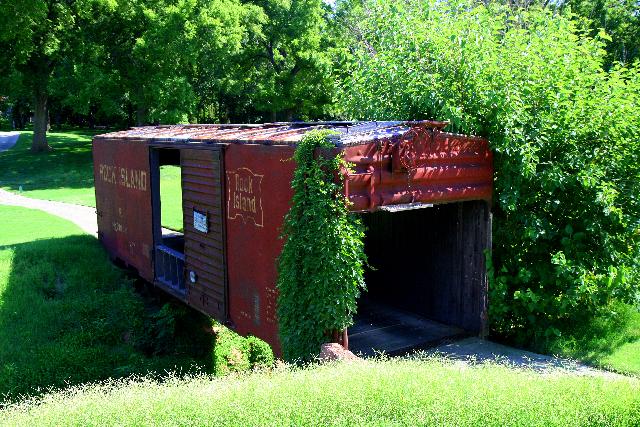
Just for laughs:

http://www.dalejtravis.com/bridge/oklah ... 36055b.htm

Image


Offline
 Profile  
 
Display posts from previous:  Sort by  
Post new topic Reply to topic  [ 38 posts ]  Go to page Previous  1, 2, 3  Next

All times are UTC - 5 hours [ DST ]


You cannot post new topics in this forum
You cannot reply to topics in this forum
You cannot edit your posts in this forum
You cannot delete your posts in this forum
You cannot post attachments in this forum

Search for:
Jump to: